Everyone searching for the best solar battery ends up in the same place – a list of brand names with specs they don’t fully understand and prices that vary wildly.
That’s why more generic comparison guides are useful, but only up to a point – because they tend to skip the part that matters most. And what’s that? It’s fully understanding what makes one battery genuinely better than another before you even look at a brand name.
For many Sydney households, the appeal of a solar battery is simple: your panels generate the most power during the day, but your home often uses the most electricity in the evening. Without a battery, that excess solar energy is usually sent back to the grid for a relatively low feed-in tariff, only for you to buy electricity back later at a higher rate. A well-matched battery helps you use more of your own solar power after dark, reduce reliance on the grid, and potentially keep essential appliances running during an outage.
So before we get to the brands we love the best, first we’ll need to establish what makes a great battery.
What separates a good battery from a great one?
We think there are 6 factors worth understanding – and once you know them, the brand decision becomes much more straightforward:
1. Usable capacity
Battery size is measured in kilowatt-hours, but the number advertised isn’t always the number you get.
Most batteries reserve a portion of their capacity to protect the cells from over-discharge, so the usable figure is what actually matters.
A 10kWh battery with 90% depth of discharge gives you 9kWh of real storage. When comparing the best solar batteries, always compare usable capacity, not headline capacity.
For most Sydney households, a system in the 10-13kWh range covers the bulk of evening consumption.
Smaller households with modest evening usage may not need that much storage. For couples, smaller homes, or properties mainly running lights, refrigeration, entertainment and basic appliances at night, a more compact battery may still provide good value without overcapitalising.
But are you in one of these categories?
- A larger home with a pool?
- Ducted air conditioning?
- EV charging?
You should look at modular systems that can scale as needs grow.
It’s also important to separate battery capacity from battery power output. Capacity, measured in kWh, tells you how much energy the battery can store. Power output, measured in kW, tells you how much electricity it can deliver at one time. A battery may have enough stored energy to last the evening, but if its output is too low, it may struggle to run several high-demand appliances together.
2. Chemistry
This one has largely been settled by the market – and the winner is lithium iron phosphate.
LFP has become the Australian standard for home battery storage, and for good reason:
- More thermally stable than older lithium chemistries
- Handles the heat of a Sydney summer better
- Has a longer cycle life
- Carries a lower fire risk.
If you’re evaluating the best battery for solar panels, LFP chemistry is the baseline you should expect from any serious contender.
3. Round-trip efficiency
Every time energy goes into a battery and comes back out, some is lost as heat. Round-trip efficiency measures how much comes back.
A battery rated at 95% efficiency returns 95 cents of every dollar of solar electricity you put in. The best home solar battery options on the market sit between 92% and 97%, with the difference compounding over years of daily cycling.
4. Compatibility with your existing inverter
This is where a lot of people get caught out. Some batteries are AC-coupled – meaning they include their own inverter and can connect to virtually any existing solar setup.
Others are DC-coupled and require a compatible hybrid inverter – if you don’t already have one, that’s an additional cost to factor in.
For retrofits, AC-coupled systems are generally simpler and more flexible. For new installations, DC-coupled systems can be more efficient.
Always confirm compatibility before committing.
5. Warranty & cycle life
A battery warranty tells you two things:
- How long the manufacturer stands behind it
- How much it’s expected to degrade.
Look for a minimum of 10 years coverage with a guaranteed remaining capacity – typically 60-70% of original. But the best solar power battery options at the premium end now offer 15-year warranties, which meaningfully changes the long-term value calculation.
As for cycle life – how many full charge and discharge cycles the battery is rated for – that matters just as much. Look for 6,000 cycles minimum, because the very best systems offer 8,000 or more.
The manufacturer’s long-term support is worth considering too. A solar battery is a major investment expected to operate for a decade or more, so warranty terms matter more when they come from a brand with a strong presence, installer network and after-sales support in Australia.
6. Backup capability
Not all batteries provide backup power during a grid outage – some simply shut down when the grid goes down, which surprises a lot of buyers.
If blackout protection is part of the reason you’re investing, confirm explicitly that the system supports whole-home or circuit-level backup, and that your inverter is configured to handle it.
The federal rebate
Before looking at any price, factor in the Cheaper Home Batteries Program, which from July 2025 applies approximately $372 per usable kilowatt-hour off eligible systems at point of sale. On a 13kWh system, that’s roughly $4,800 off the upfront cost – enough to meaningfully change which systems represent the best solar battery deals Sydney homeowners can access right now.
That rebate makes upfront comparisons more important than ever, but it shouldn’t be the only figure you look at. The best-value system is not automatically the cheapest battery on the quote. It’s the battery that delivers the right balance of usable storage, output, warranty, compatibility and real-world savings for your household. A slightly more expensive battery that suits your energy profile better may provide stronger value over its lifespan than a cheaper system that leaves you wanting more capacity or performance later.
As a general guide, installed solar battery prices can still vary significantly depending on the brand, storage capacity, inverter requirements, backup configuration and site complexity. That’s why comparing like for like matters – particularly when one quote includes retrofit work or backup functionality and another does not.
Our 3 ‘Best’ batteries right now
If we’re being direct about it, 3 batteries stand out above the rest for Sydney households in 2026. Each suits a slightly different situation – but within each category, there are alternatives worth knowing about depending on your budget and setup.
For most households: BYD Battery-Box HVM
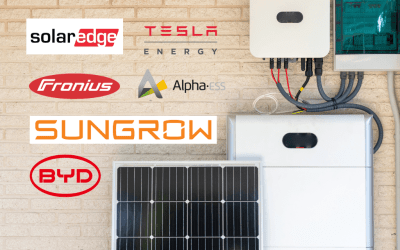
The BYD is the one we recommend most often, and the reason is simple – it works with almost any existing inverter, including:
BYD’s compatibility list covers the vast majority of solar systems already installed in Sydney homes. Add LFP chemistry, 96% round-trip efficiency, and a modular design that scales from 13.8kWh up to 66kWh, and it covers most households comfortably.
If your existing setup is compatible, this is the best solar battery storage choice for the money.
ALSO WORTH CONSIDERING HERE:
Enphase IQ Battery 5P. It’s AC-coupled like BYD, so it retrofits onto almost anything, and it carries the longest warranty available in Australia at 15 years. Per-kWh cost is higher, but for households where longevity is the priority, it’s a serious contender.
For premium buyers: Tesla Powerwall 3
If budget isn’t the primary concern and you want the best solar battery Australia has available right now without compromise, the Powerwall 3 is the answer.
- It includes a built-in inverter – simplifying installation significantly
- It delivers 13.5kWh of usable storage with 11.5kW continuous output
- Handles blackouts exceptionally well
- Comes with active thermal management built for Australian summers.
It’s the best solar power battery for high-demand households who want a set-and-forget system that does everything well.
ALSO WORTH CONSIDERING HERE:
Sonnen. The premium German alternative for buyers who want sophisticated energy management software alongside excellent hardware. Sonnen systems carry warranties up to 15 years on some models and suit households that want granular control over self-consumption and time-of-use tariffs. Price is at the top end of the market.
For budget-conscious buyers: Growatt APX HV
For households where the best 10kw solar battery price Australia wide is the primary consideration, Growatt delivers the essentials at the most accessible price point in the market – around $4,191 after the federal rebate on a 10kWh system.
Growatt is the world’s largest inverter manufacturer by volume, and their battery systems pair well with Growatt hybrid inverters. The focus here is solar self-consumption rather than heavy backup use, which suits plenty of Sydney households perfectly well.
ALSO WORTH CONSIDERING HERE:
LG Energy. Slightly higher up the price range than Growatt, but with a strong reputation for build quality and reliability. A solid middle-ground option for buyers who want more than entry-level without going to BYD or Tesla pricing.
Get the best solar battery for your setup
What is the best solar battery in Australia for your specific setup, system age, and energy profile? To really know, Solar Repair Sydney can inspect your existing system and recommend the right storage solution.
We install and service solar batteries across Sydney – Northern Beaches, North Shore, Eastern Suburbs, Western Suburbs, Hills District, and Sutherland Shire.
Get in touch for a no-pressure quote.