Our guide to the Solar Battery Rebate explores how Sydney residents can navigate the massive regulatory changes defining the 2026 energy market. While high power prices remain a headache for most households, the good news is that 2026 brings a refined suite of financial support designed to lower the barrier for home storage.
This updated 2026 framework prioritizes grid stability through the Peak Demand Reduction Scheme (PDRS) while maintaining the core benefits of the Small-scale Technology Certificate (STC) program.
By stacking these two separate incentives, homeowners in New South Wales can reduce the upfront cost of high-capacity lithium-ion storage systems. Understanding the specific deadlines for these payouts is the only way to maximize your return on investment before the scheduled mid-year subsidy reductions take effect.
How Federal Policy Changed Battery Incentives in NSW
The NSW Government paused its standalone battery installation rebate to prevent overlap with the Federal Government’s Cheaper Home Batteries Program, which started on 1 July 2025.
Because the federal scheme delivers a larger nationwide incentive, NSW changed its support toward improving grid stability instead of continuing a separate hardware subsidy. This change avoids public funding being applied twice to the same battery system.
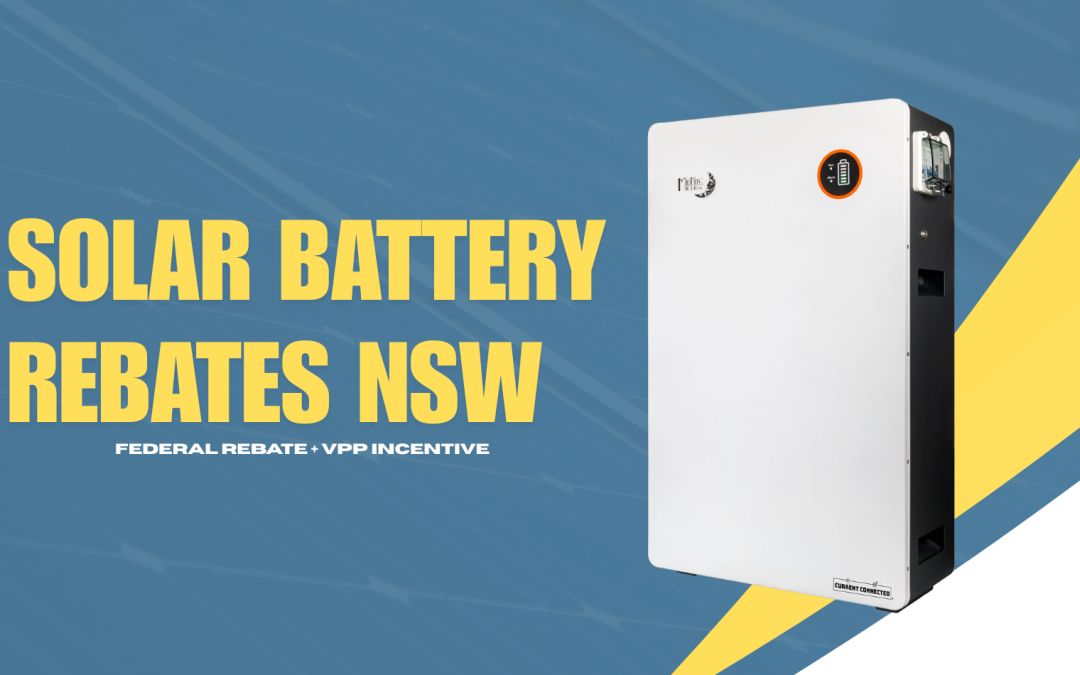
Cheaper Home Batteries Program – Discount of $252–$311 per usable kWh.
VPP Incentive (PDRS) – Upfront payment of up to $1,500.
Federal Battery Discount NSW Homeowners Can Access
The Cheaper Home Batteries Program now serves as the main financial incentive encouraging battery adoption across New South Wales.
Delivered through the Small-scale Renewable Energy Scheme (SRES), it operates much like the long-running solar panel rebate by providing an upfront discount applied directly at the time of purchase.
Battery Rebate Timeline and Rates 2026
The federal rebate is calculated based on the battery’s usable capacity and the installation date. In the first four months of 2026, the incentive reaches its highest value for the year. After that period, a scheduled adjustment lowers the rebate and introduces a revised structure for how the discount is applied.
| Installation Period | Approximate Rebate Amount | Rebate Framework |
|---|---|---|
| January 1 – April 30, 2026 | $311 per usable kWh | A single rebate rate applies to the entire battery capacity (up to 50 kWh). |
| May 1 – December 31, 2026 | $252 per usable kWh | Full rebate applies to the first 14 kWh, with lower rebate levels for additional capacity. |
Rebate Structure for Batteries After May 2026
To limit excessive subsidies for very large home battery systems, the federal government will apply a tapering structure to installations completed from 1 May 2026. Under this approach, small and mid-sized batteries still receive strong support, but the rebate value per kilowatt-hour decreases as system capacity grows:
| 0–14 kWh | Receives 100% rebate rate. |
| 14–28 kWh | 60% of the rebate rate applies to capacity within this range. |
| 28–50 kWh | 15% of the rebate rate applies to capacity within this range. |
By concentrating the highest rebate level on systems under 14 kWh, the 2026 federal program encourages households to install batteries that match evening household energy use.
NSW Incentive for Connecting Your Battery to a VPP
New South Wales no longer provides a direct hardware rebate and instead places its incentives on households that contribute stored energy back to the grid.
While the separate state installation discount ended in 2025, the Peak Demand Reduction Scheme (PDRS) still provides an upfront payment for homeowners who link their battery system to an approved Virtual Power Plant (VPP).
NSW VPP Incentive Rates by Battery Capacity
The current NSW incentive comes as either an upfront discount or a direct payment when you commit to joining an approved Virtual Power Plant (VPP). The payment is calculated using your battery’s usable capacity, with the program limit set at systems up to 28 kWh.
| Usable Battery Capacity | Estimated NSW VPP Incentive |
| 5 kWh | $275 |
| 10 kWh | $550 |
| 13.5 kWh | $742 |
| 27 kWh and above | Up to $1,500 |
Common home battery systems range from 10 kWh to 15 kWh, placing many households within the range for several hundred dollars in added state funding. Larger systems can qualify for higher payments, though the total incentive stops at the program’s maximum limit.
The Advantage of Installing a Battery in 2026
The federal government expanded the Cheaper Home Batteries Program to $7.2 billion, with funding available until 2030. Installing early in 2026 allows homeowners to access higher rebate rates before changes take effect on 1 May.
Why early 2026 works in your favor:
✔ Higher rebate rates if you install before 1 May 2026
✔ Better value from larger batteries before rebates drop after May
✔ Benefit from new batteries with built-in heating for cold weather
✔ Can install systems that meet the new April 2026 performance standard
✔ Have access to new sodium-ion batteries, a cheaper non-flammable option
Early 2026 combines higher rebates and improved battery technology, giving you a strong opportunity to install storage with better incentives and updated systems.
Who Can Receive Battery Rebates in NSW
✔ Homes with rooftop solar systems up to 100 kW
✔ Small businesses or community sites with solar installed
✔ Properties installing a new battery system
✔ Grid-connected properties able to join a Virtual Power Plant (VPP)
Take Advantage of Federal Battery Rebates and NSW VPP Programs
If you’re a homeowner in Sydney or elsewhere in NSW, battery incentives now come from a combination of federal and state programs. By pairing the Cheaper Home Batteries Program with the NSW Virtual Power Plant incentive, you can reduce part of the upfront battery cost while preparing your home for the demands of a modern electricity network.
Working with an SAA-accredited installer simplifies the process. Your installer applies the rebates during installation and confirms that your system meets the program requirements. Instead of relying only on grid electricity, you can store your solar energy, use it during peak periods, and send excess power back to the grid when demand rises.